Independent general information. Parking availability, prices, access, security, accessibility and charging rules vary by property and date. Confirm the terms attached to your own reservation.
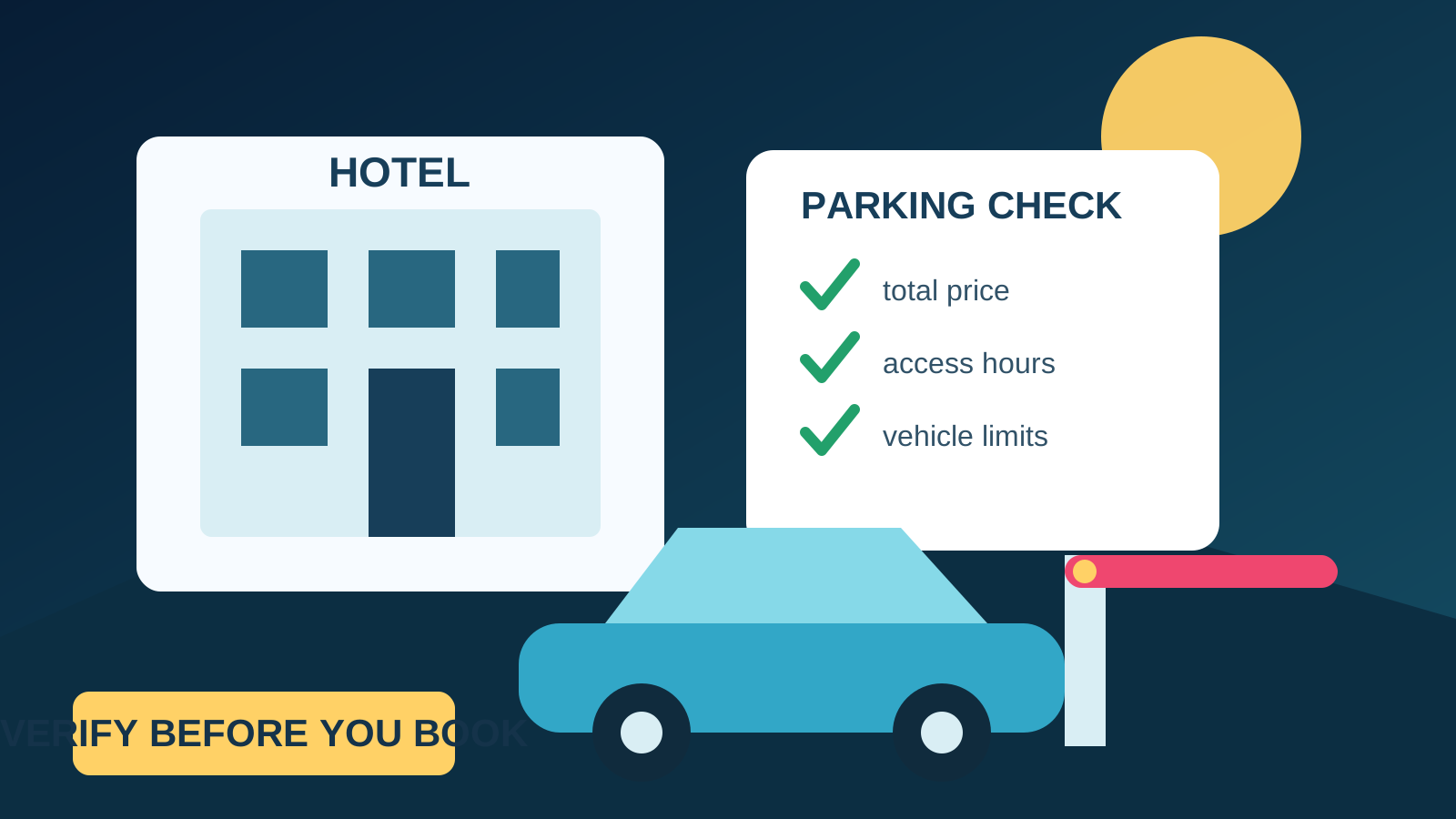
Before booking, confirm that parking is actually available for your dates, whether a space can be reserved, the complete nightly or hourly cost, entry and exit hours, vehicle-size limits, charging terms and the route from the bay to reception. Save the property’s written answer and the selected rate conditions; a parking icon alone is not a promise of a usable space.
Published 19 October 2026. This evergreen guide explains a verification process; it does not claim that any named hotel or booking platform offers parking.
The short answer: verify eight parking facts in writing
Treat hotel parking as a separate product attached to the stay, not as a pictogram. Ask the operating property to confirm eight facts for your dates: whether guests may park; whether a bay is guaranteed or first come, first served; the full price and charging period; the exact address and entrance; opening and exit hours; maximum height, width, length and weight; the walking route to reception; and the procedure if the facility is full or closed. Quote your arrival date, expected time and vehicle type so the reply is specific.
A useful answer distinguishes the hotel’s own car park from a nearby public or third-party garage. It identifies who takes payment, whether re-entry is allowed and whether the rate remains valid after checkout. Save the reply with the room confirmation and rate conditions. If the property cannot confirm a material point before the free-cancellation deadline, decide whether you can accept the uncertainty or should choose another property. Silence, an automated acknowledgement and a generic parking symbol are not confirmations.
Do this before paying when parking is essential. A room can be cancellable while a separate garage reservation is not, or the reverse. Likewise, an advertised daily rate may cover a calendar day rather than twenty-four hours. The safest comparison uses the entire stay: arrival time, intended departures, checkout, collection time and every mandatory fee. Your goal is not to eliminate all disruption; it is to replace vague expectations with dated terms and a workable fallback.
Identify who owns and operates the parking
Descriptions such as “parking available”, “parking nearby” and “private parking” do not reveal the contractual chain. The hotel may own the land, lease spaces in another building, validate tickets for a municipal garage or merely point guests toward an unrelated operator. Ask for the facility name, street address and operator. If the hotel cannot reserve or control spaces, it should not be treated as a guaranteed hotel amenity even when the walking distance is short.
The distinction matters when a barrier fails, a vehicle is damaged, a penalty notice is issued or the booking changes. The hotel may handle room complaints while the garage operator controls access, refunds and enforcement. Read both sets of terms and retain both confirmations. Check whether the vehicle registration must be entered at reception, at a terminal or in an app; a single mistyped character can prevent validation. Ask how corrections are made and obtain a receipt after registering.
Never rely on a map pin alone. A hotel entrance can be on a pedestrian street while the car park entrance is around the block, across a one-way system or inside a restricted zone. Request the driving entrance rather than the postal address. If the instructions link to an unfamiliar payment page, verify the operator through the hotel’s official contact details before entering card or vehicle information.
Calculate the real parking cost for the whole stay
Compare parking on the same time basis. A “night” may end at checkout, at noon, after a fixed number of hours or at midnight. An hourly tariff can overtake a hotel package after a delayed departure, while a supposedly flat rate may exclude taxes, booking charges, event surcharges, valet gratuities or repeated entry. Ask for the total from your realistic arrival until your realistic exit, including any grace period and the cost of an extra hour.
Confirm when payment is taken and by whom. Some properties add parking to the room folio; others require payment at a machine, through an app or directly to a valet operator. Check accepted cards, cash rules, deposits and whether pre-authorisation is required. Do not send card details by ordinary email or chat. Use the official checkout or payment channel and verify the domain. Keep the receipt because the room invoice may not show a third-party charge.
If a discounted guest rate is advertised, ask what activates it. Validation may be required every time the vehicle exits, only at checkout or before driving to the barrier. A code can expire, and a late checkout may move the vehicle into the public tariff. Consumer-information principles support clear presentation of material prices, but they do not make every parking term identical. The amount that matters is the documented total for your dates and movements.
Confirm whether a space is guaranteed
“On-site parking” answers where spaces are located, not whether one will be waiting. Ask whether the bay is reserved to your booking, allocated only after arrival or offered on a first-come basis. If a separate reservation is required, obtain its reference and cancellation terms. Where no guarantee exists, ask when the car park commonly fills and whether events, construction, coach groups or seasonal demand will reduce capacity during your stay.
Valet service is not the same as a guaranteed bay. It may operate only during stated hours, exclude certain vehicles, require the key to remain with an attendant or move the car to an off-site compound. Ask where the vehicle will be stored, how much notice retrieval requires and what happens outside valet hours. Record existing damage and remove irreplaceable items, while following the operator’s inspection procedure rather than inventing a private handover.
If you need to leave and return, confirm re-entry. Some tickets become invalid after the first exit; some garages reserve no space for returning guests; some hotel packages allow unlimited movement only while reception is staffed. State the likely number and timing of trips. A reservation that covers overnight storage but not daytime re-entry may be unsuitable even though its headline price looks lower.
Measure the vehicle against every restriction
Height is only the most visible limit. Roof boxes, bicycle racks, antennas and open tailgates can change clearance. Garages may also restrict width, length, wheelbase, turning circle, axle weight, trailers, motorcycles, vans or vehicles using LPG. Give the property the vehicle’s dimensions from the manufacturer and add fitted equipment. Do not test a marginal clearance at the barrier; obtain a safe stated limit and choose a surface facility if the margin is uncertain.
Check the entire route, not just the entrance sign. A spiral ramp, narrow lift, steep slope, tight column spacing or mechanical stacker may be unusable even when the posted maximum technically exceeds the vehicle. Ask whether staff must operate a lift or stacker and whether it remains available at your arrival time. Owners of low-clearance cars should ask about ramps and speed humps; drivers towing or carrying bikes should confirm where accessories may remain attached.
Rental-car travellers may not know the exact model in advance. Reserve by vehicle class only if the parking operator accepts a range, then recheck after collection. If a substitution exceeds the limit, contact the property before driving into the city. Do not assume a larger rental is an upgrade when parking access is fixed. Keep an alternative route that avoids restricted streets and a garage capable of accepting the actual vehicle.
Check access hours, late arrival and early departure
A car park can remain physically open while ticket validation, valet collection or pedestrian access closes. Confirm when vehicles may enter, exit and be retrieved, and whether those times differ at weekends or holidays. Match the answer to your transport schedule with a realistic delay buffer. If arrival is after reception hours, ask how the barrier opens, where the guest collects a ticket or key and which number is answered then.
Early departures need the same scrutiny. A locked pedestrian door, unstaffed payment desk or hotel validation that begins only at breakfast can trap a vehicle despite twenty-four-hour exit advertising. Ask for the complete sequence from room to street and whether a lost ticket, failed code or unreadable registration can be resolved before staff arrive. Download instructions and keep the facility address offline.
Restricted traffic zones may apply outside the car park itself. City permits, low-emission rules, pedestrian hours and road closures can change the legal route. Use the relevant public authority’s current information for your travel date and vehicle; do not treat a hotel’s old directions as an exemption. The property can explain access to its entrance, but the driver remains responsible for applicable road rules.
Verify accessibility from the bay to the room
An accessible parking symbol does not describe the complete journey. Ask whether an appropriate bay can be reserved, its dimensions, surface and distance from the accessible entrance. Verify kerbs, slopes, lighting, door widths, lifts, intercom height and the route during the hours you will use it. A lift that connects the garage to reception in daytime but is locked overnight may defeat an otherwise suitable booking.
Describe the functional requirement rather than assuming a label solves it. A wheelchair user may need side or rear transfer space; a person with limited walking tolerance may need the shortest step-free route; a traveller with visual impairment may need clear wayfinding; a parent unloading equipment may need a safe level area. Ask for measurements or photographs where they help, but obtain confirmation from the operating property rather than relying solely on guest images.
Check what happens if the designated bay is occupied or temporarily unavailable. Ask who can assist and whether an equivalent space can be protected. Public permits and hotel policies differ by jurisdiction, so confirm whether a badge, licence plate registration or local permit must be displayed. Do not promise that a badge issued in one country will automatically satisfy another system.
Treat EV charging as a timed service, not a parking label
“EV charging available” does not tell you how many connectors work, which plug and power they provide, whether charging can be reserved or whether an ordinary vehicle may occupy the bay. Ask for network, connector, maximum power, operating status, access hours and pricing. Confirm whether the tariff includes parking, electricity, a session fee and an idle charge after charging ends. A charger can be on site yet inaccessible behind a closed barrier.
Plan from the energy you need, not the charger’s headline power. Actual speed depends on the car, battery state, temperature, sharing between units and network conditions. Estimate the useful range added during the available hours and identify a public alternative compatible with the vehicle. Do not arrive nearly empty when the hotel cannot guarantee a functioning connector. If a charger reservation exists, retain its separate reference.
Check payment and app requirements before travelling. Roaming accounts, mobile coverage, card readers and pre-authorisation rules vary. Use official network channels and avoid QR codes that appear altered. Bring the appropriate cable where the unit is untethered, but never use domestic adapters or extension leads unless the operator expressly provides and permits them. Charging safety and local instructions take priority over convenience.
Assess security claims without assuming a guarantee
Words such as “secure”, “monitored” and “private” are not standard protection levels. Ask what they mean: barrier entry, staffed desk, lighting, recorded cameras, patrols or controlled pedestrian access. Then read the liability and prohibited-items terms. Surveillance may deter some incidents but does not guarantee prevention or compensation. Lock the vehicle, close windows and remove passports, medication, electronics and visible luggage whenever practical.
If keys must be surrendered, identify the operator, collection procedure and storage location. Do not leave a key with an unverified person outside the official valet process. Photograph the vehicle’s condition in the designated handover area without obstructing traffic or recording other guests unnecessarily. Report damage or access problems promptly through the stated channel and preserve tickets, receipts and times.
Consider personal safety on the walking route. Check lighting, weather exposure, stairs and whether late-night pedestrian access returns you to the same entrance. Solo travellers and families may prefer a slightly more expensive facility with a short staffed route. Security is a combination of facility controls, route design and your own decisions; no booking page can convert it into a certainty.
Prepare a realistic parking fallback
Select one alternative before departure and verify it independently. Record its official address, vehicle limits, opening hours, total likely price and route to the hotel. Check whether it accepts drive-up users or requires a reservation. A nearby map result may be resident-only, closed for construction or full during an event. Do not assume street parking is legal overnight or that payment stops when shops close.
Set a trigger for switching plans: for example, no written confirmation before the cancellation deadline, arrival outside staffed hours, a changed vehicle exceeding the limit or a reported closure. A clear trigger prevents tired circling in unfamiliar streets and reduces the temptation to stop illegally. If the hotel’s facility is full despite a guarantee, contact the property before paying elsewhere and ask it to record the failure.
Keep receipts, written confirmations, photographs of material signs and a concise timeline if a dispute follows. Use the hotel’s and operator’s complaint procedures and state the remedy sought. Reimbursement depends on the contract, evidence and applicable law; this guide cannot promise an outcome. The practical win is arriving with two verified options rather than discovering at the barrier that a single vague promise was unusable.
A message template and final checklist
Send: “Reservation [number] for [guest], [dates]. We expect to arrive at [time] in a [vehicle type and dimensions]. Please confirm: (1) whether a space is guaranteed or first come; (2) the total price from [arrival] to [exit], including re-entry; (3) the driving entrance; (4) entry, exit and pedestrian hours; (5) height, width, length and weight limits; (6) the step-free route if applicable; (7) EV connector, power and price if needed; and (8) the fallback if full.” Ask the property to answer against your booking.
Before travel, verify the room and parking references, operator, entrance address, dates, time zone, cost, payment method, registration entry, vehicle measurements, access hours, re-entry, accessible route, charger plan, valet retrieval and alternative garage. Save the confirmation and directions offline. Share them with the driver and keep sensitive booking or access codes within the travelling party.
Recheck after any material change: different car, roof box, delayed arrival, extra night or late checkout. A dependable parking plan is not the cheapest icon in a filter. It is a documented arrangement that fits the actual vehicle and timetable, plus an alternative that remains usable when the first facility cannot accept you.
Related verified hotel guides
Sources
- Your Europe — Information you should receive before buying or signing a contract, consulted 19 October 2026
- UK Competition and Markets Authority — Transparency for online accommodation booking sites, consulted 19 October 2026
- UK Department for Transport — Inclusive Mobility guidance, consulted 19 October 2026
- UK government — Electric vehicle chargepoint guidance collection, consulted 19 October 2026