Independent editorial guide. FreeHotels.info does not provide live inventory, guarantee prices or act as a booking agent. Confirm the final payable amount, currency, payment schedule, cancellation rules and property-specific conditions before purchase.
A room rate is only comparable when the dates, occupancy, room type, payment terms and unavoidable charges are the same. The lowest number on the first screen may not be the lowest payable stay, while a larger figure may include breakfast, parking or flexible cancellation that another offer leaves outside the headline price.
This guide provides a repeatable method for comparing hotel offers without inventing live prices or assuming that rules are identical across countries. It separates mandatory charges from optional extras, refundable deposits from actual costs, and booking-site presentation from the contract for the exact property and dates.
Choose the offer when
The complete unavoidable total is known, the room fits the party, essential non-price requirements are confirmed and the cancellation risk is acceptable.
Keep the offer provisional when
A local tax, mandatory fee, deposit or room configuration remains unclear; use a refundable option while seeking written confirmation.
Reject the comparison when
The offers use different dates, occupancy, room arrangements or payment terms and those differences cannot be reconciled transparently.
1. Compare the same stay, not two isolated nightly rates
Begin by fixing the facts that make an offer comparable: property, arrival and departure dates, number and ages of guests, room category, bed arrangement, meal plan, cancellation deadline, payment timing and currency. A double room for two adults is not equivalent to a family room for four, and a prepaid non-refundable rate is not equivalent to one that can be cancelled on the day before arrival. If one variable changes, note it rather than hiding the difference inside a single price column.
Create one row per offer and record the complete stay rather than multiplying a rounded nightly figure from a search result. Some interfaces average different nightly rates, while others emphasise the cheapest night or show a price before taxes. The useful number is the amount attached to the selected room and terms for the entire booking. Capture the date and source of the quote because hotel pricing and availability can change.
- Use identical dates and occupancy for every quote.
- Record the precise room and rate-plan names.
- Keep the displayed currency and quote time.
2. Separate mandatory charges from optional choices
A mandatory charge belongs in the comparison whenever the guest must pay it to complete or use the selected stay. Depending on the destination and property, that can include taxes, booking charges, resort or destination fees and other unavoidable amounts. An optional breakfast, airport transfer, spa treatment or late checkout should not be added automatically when the traveller can decline it. It should appear in a separate column if it is actually needed.
This distinction is reflected in official price-transparency guidance. The US Federal Trade Commission requires the total price for short-term lodging to include mandatory fees when a price is offered or advertised, while optional ancillary services may be presented separately when their cost is clearly disclosed before payment. The UK Competition and Markets Authority similarly explains that unavoidable charges should normally be included in the total. These rules help interpret a quote, but the traveller must still check which jurisdiction and seller apply.
3. Read taxes by amount, timing and person
Taxes can be calculated per room, per person, per night or as a percentage. Some depend on age, residency, destination, property category or length of stay. A phrase such as “taxes may apply” is therefore not enough for a reliable comparison. Record the estimated amount shown for the actual party and dates, identify what will be collected online or locally, and ask the property or seller when the booking flow cannot calculate it.
Do not assume that a tax collected at check-in is optional merely because it is absent from the card payment today. Conversely, do not add a tax twice when the total already includes it. Retain the price breakdown or confirmation page. In cross-border bookings, note the currency used for locally collected taxes, because converting an estimate into your home currency introduces exchange-rate uncertainty.
4. Treat deposits and card holds as liquidity, not automatically as cost
Hotels may require a refundable security deposit or pre-authorisation to cover incidentals. If it is fully released after the stay, it is not the same as a mandatory fee. It can nevertheless matter greatly: the amount may reduce the spending power available on a debit card or occupy part of a credit limit, and the release may not appear immediately after checkout. Ask for the amount, accepted payment method and typical release process.
Distinguish a card verification, a temporary hold, a deposit charged and later refunded, and an advance payment applied to the room bill. The words used by booking interfaces are not always consistent. The confirmation should explain whether the money is captured, when it becomes refundable and which events allow deductions. If a traveller cannot absorb the temporary amount, the offer may be impractical even if its final price is low.
5. Inspect resort, destination and facility fees line by line
A resort fee may be described as paying for Wi-Fi, a pool, a fitness room or other facilities, but if it is imposed automatically for the stay it is mandatory for comparison purposes. The FTC’s fee guidance gives the example of a hotel that automatically charges a resort fee at check-in: the fee belongs in the total even when staff might waive it after a complaint. A traveller should not budget on the assumption that challenging a charge will succeed.
Check whether the fee is per room or per guest, whether tax is added to it and whether it applies on every night. Also verify what happens when a facility is closed, because the answer is contractual and property-specific. FreeHotels.info does not infer that a fee is refundable simply because an amenity is unavailable. The goal is to expose the full amount before comparing, then decide whether the included facilities have value.
6. Occupancy rules can change the entire calculation
A headline rate may cover fewer guests than the search form appears to accept. Verify maximum occupancy, child age bands, extra-person charges, cot or rollaway-bed costs and whether the room contains the promised sleeping surfaces. A family may need two rooms under the property’s occupancy policy even when everyone could physically fit into one. In that case, the relevant comparison is the cost of the required room configuration.
The same discipline applies to connecting rooms. A request is not necessarily a guarantee, and paying for two rooms does not always guarantee that they will be adjacent. If the arrangement is essential, obtain written confirmation of what is guaranteed and what remains a preference. Add any compulsory extra bed or second room to the total; keep genuinely optional upgrades outside it.
7. Add only the extras the trip really requires
Breakfast, parking and transport can reverse an apparent price advantage, but they should be evaluated against the real itinerary. Add parking only when a car will be used. Compare breakfast only when the party intends to eat it and the included plan covers every guest. A hotel outside the centre may require daily train fares or taxi trips; a central hotel may remove those costs even with a higher room rate.
Use conservative, documented assumptions. Check the official parking page, local transport operator and meal-plan conditions instead of inserting a generic estimate. Where the future cost cannot be known, record a range and the reason. Never treat optional minibar use, room service or leisure spending as inevitable. The worksheet should model the planned stay, not create an inflated total.
- Parking: price, vehicle limits and re-entry rules.
- Breakfast: guests covered, service times and taxes.
- Transport: realistic journeys from the exact property.
8. Price cancellation risk instead of ignoring it
A non-refundable rate can be cheaper because the traveller accepts more risk. Record the deadline, time zone, penalty and payment schedule for every offer. “Free cancellation” may end days before arrival, may exclude the first night or may apply only when cancellation occurs through the original booking channel. An offer that can be cancelled does not automatically mean that payment is delayed.
Choose flexibility according to the likelihood and financial impact of change. A stable local trip may justify a different decision from an international journey involving visas, connecting transport or uncertain medical circumstances. Do not invent a monetary value for flexibility merely to make a spreadsheet look precise. Present the price difference and the maximum cancellation loss side by side, then make the risk decision explicitly.
9. Currency conversion can create a second price difference
When a hotel quotes in another currency, record both the original total and any home-currency figure shown. The conversion offered by a booking site or payment terminal may use a different rate and margin from the card issuer. Dynamic currency conversion can make the amount look familiar without necessarily making it cheaper. The traveller should check the card’s foreign-transaction terms and choose deliberately.
Avoid pretending that today’s conversion guarantees the amount charged later. A pay-at-property reservation can be exposed to currency movement until settlement. If a seller guarantees a converted amount, retain the exact terms. If not, use the foreign-currency total as the contractual reference and treat the home-currency figure as an estimate rather than a promise.
10. Compare direct and intermediary offers without assumptions
A direct hotel offer and an online travel agency offer can differ in room name, cancellation support, loyalty benefits, payment processor and customer-service path. Neither channel is automatically cheaper or safer. Open the final review screen for each, match the conditions, and identify who takes payment and who must handle changes. A discount label is meaningful only when the reference offer is genuinely comparable.
The European Commission’s accommodation-booking enforcement work emphasises total prices including foreseeable mandatory charges and clearer presentation of discounts and scarcity statements. Use messages such as “only one room left” as information about that seller’s inventory, not proof that no other channel or room exists. Check the exact terms instead of allowing urgency language to replace comparison.
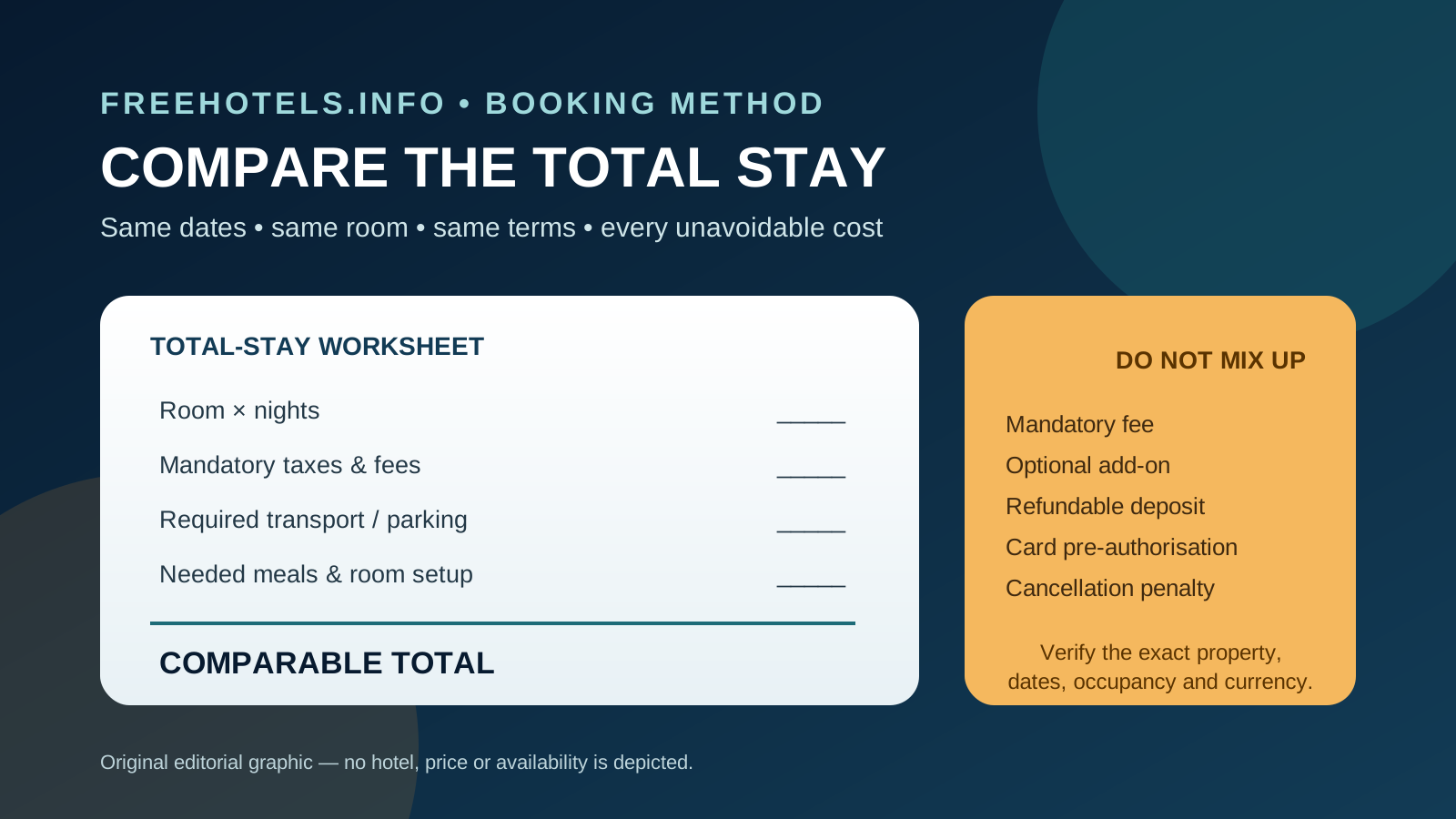
11. Use a five-column total-stay worksheet
A practical sheet needs only five columns: offer identity, unavoidable total, required trip extras, temporary funds blocked, and cancellation exposure. Under offer identity, record the seller, room, occupancy, meal plan and timestamp. The unavoidable total contains the room and every mandatory charge. Required extras contain only planned necessities such as parking or transport. Deposits and holds remain visible without being mislabelled as spent money.
The fifth column states the maximum amount at risk if the trip is cancelled at relevant dates. Add a notes field for accessibility, check-in limits or other requirements that can make a cheaper offer unusable. Rank options only after every row is complete. The result may be a range rather than a single number, but an honest range is more useful than a precise-looking total built from missing fees.
- Unavoidable payable total.
- Necessary extras for this itinerary.
- Refundable deposit or pre-authorisation.
- Cancellation loss and deadline.
- Non-price requirement confirmed or unresolved.
12. Recheck the final payment screen and confirmation
Immediately before paying, compare the final screen with the worksheet. Confirm dates, guest count, room, currency, taxes, mandatory fees, deposit information, cancellation policy and payment schedule. Remove any preselected optional product that is not wanted. If the price changes, determine which component changed rather than assuming the first offer remains available.
After purchase, save the confirmation and breakdown. Contact the seller promptly if the booked terms differ from what was displayed. Keep correspondence factual and request a specific correction or explanation. Legal remedies vary by country and contract, so official consumer authorities or professional advice may be necessary for a dispute. This guide is a comparison method, not individual legal advice.
Related verified hotel guides
- Verify hotel accessibility before booking
The existing French checklist shows why room-level confirmation matters for non-price requirements.
- FreeHotels.info travel guides
Methods for checking accommodation claims and planning the complete stay.
- Hotel industry news in English
Corporate announcements are analysed separately from live booking conditions.
Common questions
Should a mandatory resort or destination fee be included in the comparison?
Yes. If the fee cannot reasonably be avoided for the selected stay, include it in the total even when it appears on a separate line or is collected at the property.
Is a refundable deposit part of the hotel price?
Usually it is not a final cost if it is fully released, but it affects the cash or credit available during the trip. Record it separately with the amount, payment method and expected release time.
Can two offers be compared when their cancellation terms differ?
They can be compared only after the difference is made explicit. Treat flexibility as a feature with a cost and compare both the payable total and the financial risk if plans change.