Independent general information, not medical or legal advice. Building rules and service duties vary by country, property age and alteration history. Confirm your own requirements directly with the operating property and relevant transport providers.
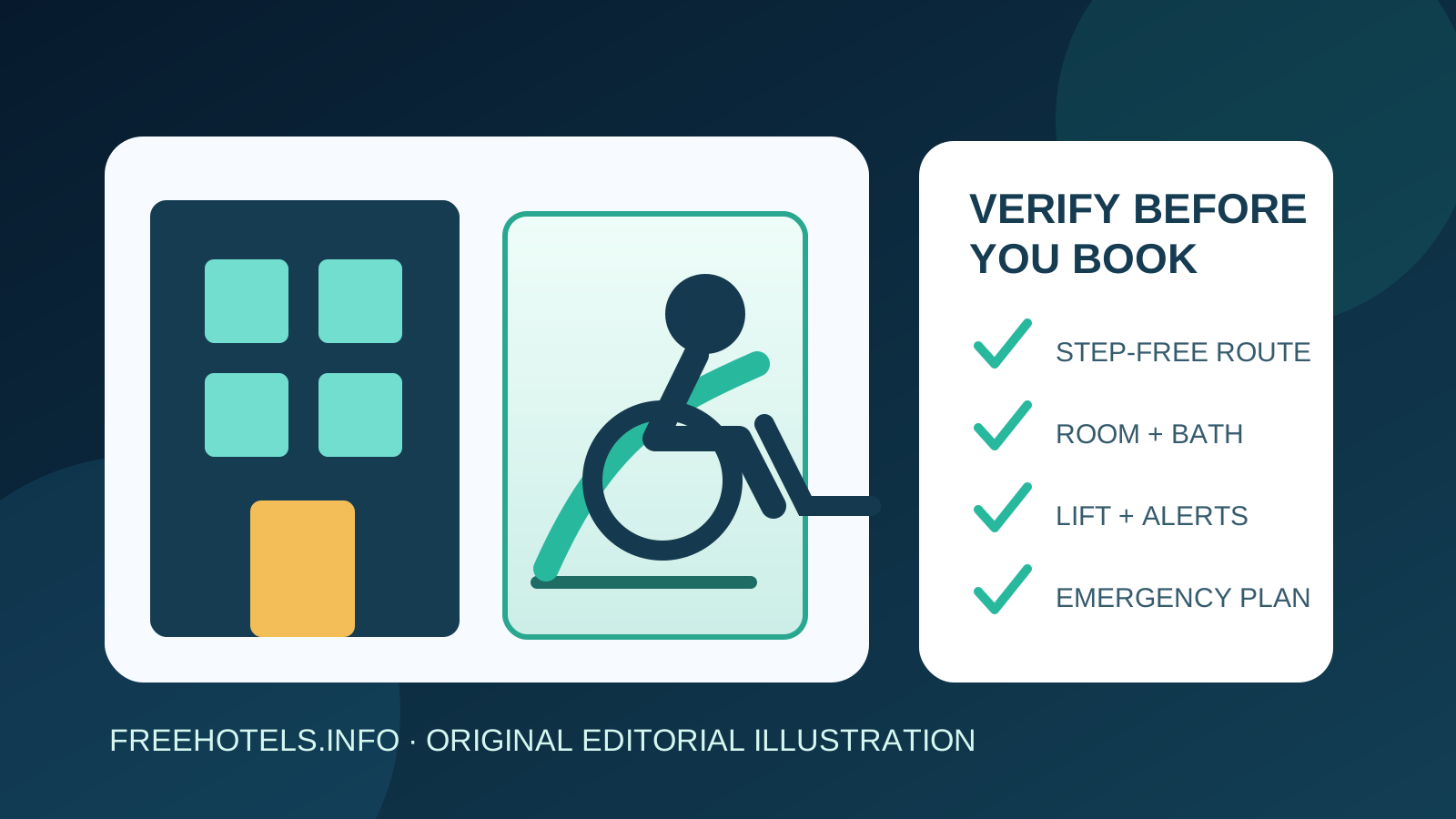
Before booking, describe the access features you actually need and ask the operating hotel to confirm the complete route from arrival point to room, the exact room and bathroom layout, lift dimensions, communication features, emergency arrangements and any unavailable facilities. Request measurements or current photographs when a detail is decisive, tie the answer to your dates and room category, and save the written confirmation before the cancellation deadline.
Published 20 October 2026. Accessibility is individual: a label or icon cannot show whether a hotel works for every guest.
The short answer: verify the whole journey, not an accessibility icon
Start with a functional description rather than a diagnosis. Tell the property whether you need step-free access, a particular turning space, a roll-in shower, a bath, grab rails, a lower bed, visual alarms, a hearing loop, quiet orientation, a refrigerator for medication or help carrying equipment. Then ask staff to trace the route from pavement, car park or drop-off through the entrance, reception, lift, corridor and bedroom. A single step or narrow doorway anywhere in that chain can make an otherwise adapted room unusable.
Ask the operating hotel to identify the exact room category available for your dates and to confirm that the requested features are attached to the reservation, not merely entered as preferences. Request measurements for any critical clearance and recent photographs of the actual room type when descriptions are vague. Save the reply, rate conditions and cancellation deadline. If the hotel cannot answer a decisive question, treat that uncertainty as a booking factor instead of assuming an icon guarantees compatibility.
Accessibility is not one universal specification. A room that works for a manual-wheelchair user may not fit a large powered chair; a shower seat may be fixed, loose or absent; a visual alarm does not necessarily cover the doorbell and telephone. The useful question is therefore not “Is the hotel accessible?” but “Can this route and this room support these stated needs on these dates?”
Map arrival, parking and the step-free entrance
Begin outside the building. Identify the safest drop-off point, the surface between vehicle and door, kerbs, gradients, cobbles, ramps, automatic doors and any threshold. If parking matters, confirm whether an accessible bay can be reserved, its width and height clearance, the distance to reception and whether the route remains open overnight. A hotel may advertise accessible rooms while the only practical entrance is around the back, across a slope or through a locked service door.
Ask whether taxis and adapted vehicles can reach the entrance during road closures, pedestrian-zone hours or events. For rail or air arrivals, examine the final transfer separately; the rights and assistance attached to transport do not prove that the pavement or hotel entrance is accessible. Your Europe explains that passengers with disabilities or reduced mobility can have assistance rights across several transport modes, but travellers still need to coordinate notices, meeting points and the last route to accommodation.
Late arrival changes the risk. A ramped main entrance may close when reception does, while the night door has steps or a heavy manual door. Ask for the after-hours route and the telephone number answered then. If an entrance platform lift is required, confirm that it is available without a staff key and that an employee trained to operate it will be present. Save a backup hotel or staffed location that can actually receive you at the relevant hour.
Confirm doorways, lifts and circulation with measurements
Terms such as “wheelchair friendly” and “spacious” are not measurements. Where clearance is decisive, ask for the narrowest clear opening of the entrance, bedroom and bathroom doors, the corridor pinch points, lift door width and lift-car dimensions. Confirm whether a route includes tight turns, thick carpets, raised fire thresholds or doors that require significant force. Measurements should describe clear usable space with furniture and door swings in their normal positions.
Do not apply one country’s design number as a worldwide promise. In the United States, the Department of Justice’s 2010 ADA Standards contain technical and scoping requirements for covered new construction and alterations, including transient lodging. The date and scope of those rules matter, and an older property is not automatically described by the newest standard. Outside the United States, other national and local regimes apply. Use legal standards as context, then verify the real property and route.
Ask what happens if the main lift is out of service. Is there another lift on an accessible route, can the reserved room be placed on the entrance level, and who can help without separating a guest from essential equipment? Confirm lift access to breakfast, meeting rooms, spa, pool and emergency exits rather than only to bedrooms. If only some floors are served, record the floor and room category the hotel commits to.
Verify the bedroom around real transfers and equipment
Request the bed height from floor to top of mattress, the clear space beside the bed and whether furniture can be moved safely before arrival. State which side needs transfer space and whether both sides must remain accessible. Ask about the position of switches, curtains, sockets, thermostat, telephone and peephole. If using a hoist, confirm under-bed clearance, room for the device and whether the hotel permits the equipment; never assume a generic accessible room can accept every hoist.
For mobility scooters or powered chairs, ask where charging is permitted, whether the electrical supply and plug type are suitable, and whether equipment may be stored without blocking an escape route. Do not leave batteries charging in a corridor or improvise with unsuitable adapters. If oxygen, refrigerated medication or other health equipment is involved, discuss storage and power continuity through the property’s official process while sharing only information needed to arrange the service.
Connecting rooms, twin layouts and carer accommodation require separate confirmation. An accessible room may not connect to the category shown beside it, and a companion room may be sold independently. Ask whether the connection is guaranteed for your dates, how many beds are fixed, and whether an extra bed would consume the transfer area. Put the agreed configuration in the reservation and recheck before the penalty-free cancellation point.
Inspect the bathroom feature by feature
Bathroom labels hide the most important differences. Ask whether access is level or uses a lip, whether the shower is roll-in or over a bath, and the height and stability of any seat. Confirm the location and type of grab rails, the usable floor space, toilet height, approach direction, basin clearance, mirror position, taps and reachable controls. A photograph should show the complete room, not a cropped rail that conceals a step or glass screen.
If you need assistance, describe the space required for the assisting person and equipment. Confirm whether the bathroom door opens inward or outward and whether it can be unlocked from outside in an emergency. Ask about water controls, hand-held shower reach, anti-slip surfaces and drainage. Do not rely on staff moving fixed sanitary equipment or promising an unsafe workaround after arrival; select a room whose permanent layout already works.
Portable seats and suction rails should not be treated as equivalent to fixed features without assessing their intended use and installation. If the hotel offers temporary equipment, request its model, dimensions, weight limit, installation method and a current photograph. Confirm who checks it before arrival. Where personal equipment is hired locally, coordinate delivery, storage and pickup directly with an authorised provider and obtain written acceptance from the property.
Check communication, sensory and digital access
Access needs also include hearing, vision, cognition, speech and sensory processing. Ask whether alarms provide visual or vibrating notification, whether the door knock or bell has an alternative signal, and whether reception can communicate by text or another agreed channel. Confirm lighting, contrast, tactile or Braille signs, audible lift announcements and assistance with printed information. A room with mobility features does not automatically include communication features, and the reverse can also be true.
Review the booking process itself. Can essential room features be identified and reserved without a telephone-only barrier? Does the confirmation state the adapted category? Can online forms be completed with assistive technology? If the website is inaccessible, use an official alternative channel and keep the response. Do not send medical records merely to request ordinary features. Explain the practical adjustment needed and ask the hotel how it will confirm delivery.
For sensory requirements, ask about connecting doors, lift machinery, function rooms, flashing indicators, strong fragrances, bedding materials and the possibility of a quieter route. No room can be guaranteed silent or allergen-free in every circumstance, so seek specific operational facts rather than absolute promises. Record what the property controls, what it will attempt and what remains uncertain.
Treat restaurants, pools and shared facilities separately
An accessible bedroom does not prove access to breakfast, toilets, terrace, bar, gym, pool or beach. Trace the route to each facility you intend to use and ask about steps, lifts, opening hours, seating, changing areas and accessible toilets. The UK travel guidance specifically recommends checking access to rooms, restaurants, bars, toilets, pools and beaches, as well as whether lifts can accommodate a traveller’s equipment.
For pools and spas, confirm the actual means of entry, its availability and staff procedure. A photograph of a handrail is not proof of a lift or sloped entry. Ask whether the route from changing area to water is step-free and whether wet surfaces or doors create barriers. Services can be seasonal or temporarily closed, so tie the answer to your stay dates and avoid choosing the property solely for a facility that cannot be confirmed.
Breakfast buffets can create reach and circulation problems even in level rooms. Ask whether staff assistance and table service are available, whether dietary information can be supplied in an accessible format and whether seating can accommodate equipment. For conferences or weddings, verify the specific event room and accessible toilet during the event hours. Do not assume the route used on an ordinary daytime visit remains open after private functions begin.
Plan emergency information and evacuation before arrival
Ask how the property handles emergency alerts and evacuation for the features you have described. The answer should identify notification, the route or refuge arrangement, staff availability and how a personal evacuation plan is discussed when appropriate. UK fire-safety guidance states that where sleeping accommodation such as a hotel is provided, the booking-in procedure should offer a suitable escape plan for disabled residents and accessible information should accompany room evacuation procedures.
Do not accept “the lift will be used” without clarification; ordinary passenger lifts may not operate during a fire unless specifically designed and managed for evacuation. Ask what happens at night, who is on duty and how staff know assistance may be required. Share only necessary functional information and check it again at arrival. Emergency planning is not a reason to refuse reasonable participation, but it must be credible rather than improvised.
Keep essential medication, communication devices and mobility aids within reach, and learn two ways to contact staff if possible. Read the room notice and report inaccessible information immediately. If the plan depends on equipment that appears absent or broken, ask for correction or a safe alternative before settling in. A written pre-arrival promise is valuable, but the arrival check confirms whether the real conditions match it.
Make a request the hotel can answer precisely
Send a numbered message: “For reservation [number] on [dates], please confirm: (1) a step-free route from [drop-off/parking] to reception and room; (2) narrowest door and lift clearances; (3) bed height and transfer space; (4) shower type, seat and grab-rail layout; (5) communication features; (6) access to [named shared facilities]; (7) emergency-arrangement contact; and (8) that the confirmed room category will be reserved, not merely requested.” Add only the measurements and features relevant to you.
Ask the property to distinguish guaranteed features from requests. A note in a booking record may mean staff will try, not that a room has been allocated. If a platform agent relays the message, seek acknowledgement from the operating hotel. Compare the hotel response with the final confirmation and keep both. When a material requirement is missing, use the cancellation window rather than hoping a solution appears at check-in.
Call when conversation is easier, but follow with a written summary and invite correction. For example: “Thank you for confirming that the booked room has a roll-in shower and that the route from the north entrance is step-free. Please reply if I misunderstood.” Record the staff department rather than publishing a person’s name. Reconfirm several days before arrival when the booking was made far in advance.
Audit the room on arrival without losing your remedy
At check-in, ask staff to repeat the essential route and emergency information, then inspect the room before unpacking extensively. Compare the doorway, transfer space, bathroom, controls and alerting equipment with what was confirmed. If something material differs, report it immediately through reception and the booking channel. Take limited photographs of the feature, avoiding staff, other guests, documents and private information.
Ask first for a safe equivalent room or a prompt correction that does not create a new hazard. If none exists, request written confirmation of what is unavailable and the options offered. Do not accept a downgrade, extra charge or distant room without understanding the effect on access and the rate. Keep reasonable replacement receipts if relocation becomes necessary, but do not promise yourself a refund: remedies depend on the contract, jurisdiction and facts.
Separate inconvenience from immediate safety. A missing bedside socket may be solvable; an inaccessible toilet or blocked evacuation arrangement may make the room unusable. If a dangerous condition exists, prioritise a safe staffed location and appropriate local help. Complaints and compensation can be handled afterward with the booking, messages, photographs, invoices and timeline.
Final accessibility checklist before you pay
Confirm the complete arrival route, parking or drop-off, night entrance, door widths, lift dimensions, room floor, bed height, transfer side, bathroom layout, fixed and portable equipment, communication features, climate controls, charging, shared facilities, emergency plan and the precise room category. Add the hotel’s answer date and cancellation deadline. A checklist should reflect your requirements; irrelevant boxes can distract from the one feature that determines whether the stay works.
Verify transport assistance independently and allow the required notice. Check that the final segment from station or airport to hotel is possible at your arrival time. Store confirmations offline and carry official contact details. If a piece of hired equipment is essential, confirm supplier, delivery time, storage, collection and who accepts it. Keep a realistic backup whose accessibility has also been checked rather than merely listed.
No website badge, star rating or legal citation replaces property-specific evidence. Standards can establish duties and design requirements, while old buildings, alterations, temporary outages and room allocation still shape the stay. The strongest booking file combines a clear functional request, measurements or photographs for decisive features, a room-specific written confirmation, an emergency discussion and an arrival inspection. That process cannot remove every risk, but it replaces vague assumptions with facts you can act on.
Related verified hotel guides
Sources
- US Department of Justice — 2010 ADA Standards for Accessible Design, consulted 20 October 2026
- US Department of Justice — Guidance on the 2010 ADA Standards, including transient lodging guest rooms, consulted 20 October 2026
- UK Foreign, Commonwealth & Development Office — Disability and travel abroad guidance, consulted 20 October 2026
- UK Government — Means of escape for disabled people, consulted 20 October 2026
- Your Europe — Rights for travellers with disabilities or reduced mobility, consulted 20 October 2026