Independent general travel information, not medical, dietary or legal advice. Menus, ingredients, kitchen practices, prices and hours change. Travellers with allergies should contact the operating property directly and follow advice from their clinician.
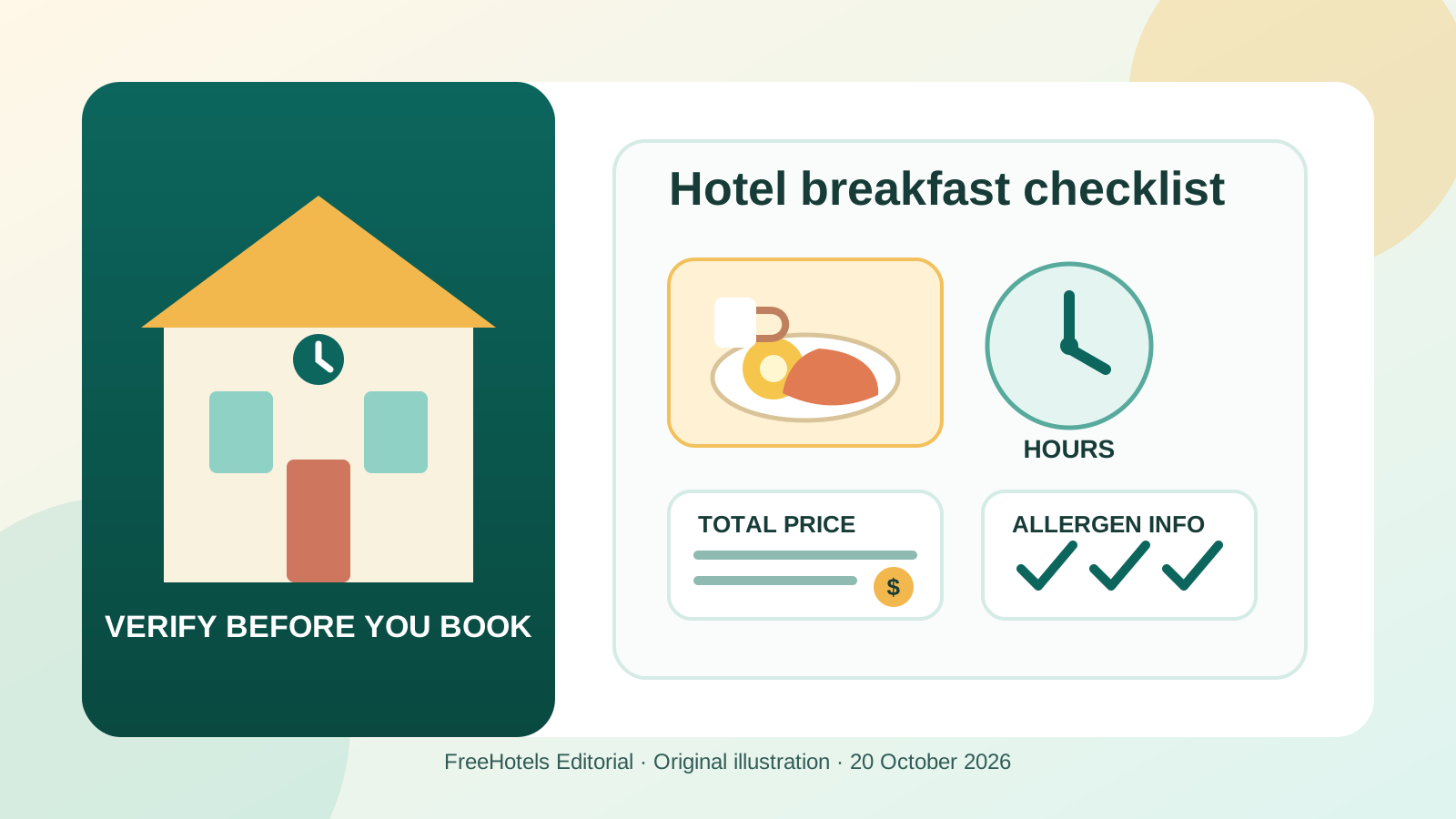
Before booking, ask the operating hotel whether breakfast is included in your exact rate, the full adult and child price, serving hours on your dates, the service format, and how it handles your dietary or allergen needs. Request a current written answer tied to the property and rate. Compare the total stay cost, then identify a nearby backup if breakfast timing or safety cannot be confirmed.
Published 20 October 2026. Hotel breakfast terms can vary by property, date, room package, occupancy and local law, so a brand-wide amenities page or an old guest review is not a reliable promise for a particular stay.
The short answer: verify the exact rate, dates and property
A breakfast icon is not a contract. Begin with the exact hotel, arrival and departure dates, room type, number and ages of guests, and the rate you intend to purchase. Ask whether breakfast is included every morning, only on selected days, or only for particular occupants. A chain may offer several packages with similar names, while a third-party listing can combine room-only and breakfast-inclusive rates on the same screen.
Request the answer from the operating property rather than relying solely on a brand call centre. Ask staff to identify the restaurant or breakfast area, normal serving format and current hours for weekdays, weekends and public holidays during your stay. Conference dates, renovations, low occupancy or an early departure can change the service. Save the reply, rate description and cancellation deadline with the reservation.
If an answer is vague, calculate the stay as room-only and treat any meal as an optional purchase. Compare the complete difference between rates, not a headline nightly price. A package can look economical until it excludes a second guest, children, tax, service charge, drinks or the final morning. The useful question is what your party can actually eat, when, and for what total amount.
Confirm exactly who receives breakfast and on which mornings
Ask whether inclusion applies per room, per registered guest or to a fixed number of adults. Some packages cover two adults even when a room accommodates more people; others charge separately for children above a stated age. Confirm the age bands, identification or room-key requirements, and whether an infant seat or suitable food can be requested. Do not assume that an extra bed automatically adds a breakfast entitlement.
Count the mornings carefully. A two-night stay normally involves two breakfasts, but an overnight arrival after midnight, a day-use booking or a package tied to calendar dates can create ambiguity. Ask whether the departure morning is included and whether a missed breakfast can be transferred, refunded or replaced. Most hotels will not promise a credit unless the rate terms say so.
Group, event, loyalty, voucher and corporate rates may follow different rules from the public listing. Ask whether elite benefits are guaranteed, subject to the programme and property, or replaced by lounge access or a credit. If a credit is offered, confirm its value, eligible outlets, daily expiry and whether unused amounts carry over. Keep promotional language separate from the final booking terms.
Calculate the real breakfast price before comparing rates
For a room-only rate, request the current walk-in price for each adult and child, including any mandatory tax or service charge. Ask whether pre-purchasing during booking is cheaper, whether the advance price is refundable, and whether every night must be added. Multiply by the number of eligible guests and mornings. Then compare that figure with the breakfast-inclusive rate under the same cancellation and payment conditions.
A cheaper package is not automatically better value. Check whether it requires prepayment, narrows the cancellation window, removes points or uses a smaller room. Conversely, paying at the property may preserve flexibility but expose you to a price change or capacity limit. Record both the monetary difference and the contractual difference. The correct comparison keeps room, dates, occupancy and flexibility constant.
Ask what the price includes: buffet, set menu, continental selection, hot dishes, coffee, specialty drinks, room service or gratuity. A food-and-beverage credit may not cover tax, delivery, tips or every outlet. If breakfast is served by a neighbouring café, confirm the voucher value, menu exclusions, opening days and distance. Do not describe a benefit as free when it is embedded in a higher rate.
Match serving hours to your actual itinerary
Write down the earliest time you must leave on each day. Compare it with the time food is genuinely available, not the time the restaurant doors open for setup. Ask when hot items, coffee and takeaway options begin, when the last seating occurs, and whether the buffet is cleared before the published closing time. Airport transfers, tours and meetings can make a nominal inclusion unusable.
Check weekday, weekend and holiday schedules separately. A property may begin later on Sunday, reduce service during low season or move breakfast during renovations. If you arrive late, ask whether booking a breakfast slot is necessary and whether slots can sell out. Large tour groups can create queues even when service is technically open, so ask about expected peak periods rather than demanding a guarantee.
For an early departure, ask whether the hotel offers an approved breakfast box, what it contains, when it must be ordered and where it is collected. Confirm refrigeration needs and whether the substitute is included or charged. A bag left at reception is not equivalent to a full buffet, and it may be unsuitable for allergies or dietary needs. Price an independent airport or station alternative before relying on it.
Identify the service format and what will actually be available
The word breakfast can mean a full buffet, a plated menu, continental items, a lounge spread, a voucher, or only coffee and packaged food. Ask for a current menu or representative list and the likely format on your dates. Photographs are useful for orientation but may show a launch event, upgraded room, seasonal display or another property. Treat images as examples unless the hotel confirms them.
If a buffet matters, ask whether hot dishes are replenished throughout service, whether made-to-order items cost extra, and whether seating is shared with events. For a set menu, confirm the number of choices and whether substitutions are possible. If room service is the only early option, request the menu, delivery window, tray charge, minimum spend and ordering deadline.
Travellers who need familiar food, high-protein options, fruit, whole grains, plant-based milk or a culturally appropriate meal should name the requirement without assuming a label means the same everywhere. Ask what is routinely stocked and what requires advance notice. A staff member’s willingness to try is helpful, but it should not be presented as a guaranteed menu or a medically safe preparation.
Treat allergy questions as a separate safety check
A menu label or general statement cannot establish that a meal is safe for one person. Tell the hotel the specific allergen, ask how ingredient information is provided, and ask whether staff can explain cross-contact controls. In the European Union, allergen information is required for non-prepacked food; the European Commission also explains that this information may be communicated verbally under national arrangements, with clear access to it and written information available on request.
The UK government’s consumer guidance likewise says restaurants must provide accurate information about the regulated allergens. In the United States, the FDA identifies nine major food allergens and warns that reactions can be serious. These frameworks differ, and none turns a shared buffet into a risk-free environment. Ask the property which rules and procedures apply locally rather than importing assumptions from home.
Buffets create particular uncertainty because guests share utensils, move food and spill between containers. Ask whether individually packaged items, a separately prepared plate or an unopened product with a readable label is available. Do not ask staff to promise zero risk when they cannot control the environment. Travellers with diagnosed allergies should follow their clinician’s plan, carry prescribed emergency medication and know how to obtain local emergency help.
Verify dietary, religious and lifestyle options without relying on labels
Terms such as vegan, vegetarian, halal, kosher and gluten-free can describe ingredients, preparation, certification or merely one available item. Ask what the hotel means, whether certification exists, whether cookware and serving utensils are shared, and whether advance notice is required. A fruit bowl may be vegan but does not necessarily provide a substantial breakfast, while gluten-free bread may be handled beside ordinary toast.
For medical diets, ingredient and cross-contact questions belong in the allergy or clinical discussion, not in a broad preference label. For religious observance, ask about certification, sealed meals, preparation area, service times and holiday arrangements. Staff should be allowed to say that a requirement cannot be met. A clear limitation before purchase is safer and more useful than an improvised promise after arrival.
If the property can provide only part of the requirement, build a practical alternative. Locate a grocery store, certified bakery, café or delivery service and verify opening hours for the relevant day. Check whether the room has a refrigerator or kettle and whether outside food is permitted in breakfast areas. Do not use cooking appliances that the accommodation forbids.
Check access, seating and the route to breakfast
Breakfast is only useful if every traveller can reach and use it. Ask where the dining room is, whether the route is step-free, whether lifts operate during service, and whether accessible seating can be reserved. Confirm table height, aisle width and restroom access when those details matter. A general accessible-room label does not prove that the restaurant route meets an individual’s needs.
Ask whether trays, assistance carrying food, large-print information, quiet seating or an alternative service can be arranged. For sensory needs, find out when the room is least busy and whether music, bright lighting or live cooking is typical. Families may need highchairs or space for a stroller. The answer should be tied to actual facilities, not a generic promise that staff will help.
If breakfast is in another building or a partner café, check distance, gradients, crossings, weather exposure and opening access. A five-minute walk in marketing copy can be a serious barrier with luggage, a mobility aid or young children. Compare the alternative with the hotel’s room-only price and a closer venue. Preserve accessibility needs when changing rates or properties.
Look beyond reviews and verify recent operational facts
Recent reviews can reveal recurring queues, limited choice or excellent service, but they do not prove current price, hours or ingredients. Check the review date, traveller type, room package and whether management reported a later change. Ignore copied lists and reviews that discuss another branch. Use reviews to generate questions, then obtain a property-specific answer through an official channel.
Menus posted online can become stale. Look for a date, property address, currency and booking link, then ask whether the document still applies. Social-media stories may show special brunches rather than the everyday breakfast. A search result snippet can also preserve an old price after the page changes. Save the live terms at purchase and take a screenshot only for your own booking record.
Call after emailing when the requirement is important, then send a concise summary: exact dates, rate, occupancy, hours, price and agreed accommodation. Invite the hotel to correct it. This reduces misunderstandings without pretending that ingredients or operations can never change. Reconfirm shortly before travel if the booking was made months earlier or depends on a seasonal service.
Prepare a backup that works if the hotel answer changes
Identify at least one realistic nearby option and verify its opening days, reservation rules, dietary information, price and travel time. A café that opens after your tour departs is not a backup. In remote locations, buy suitable sealed food before arrival where lawful and practical. Keep food storage and import restrictions in mind when crossing borders.
If breakfast is the reason for choosing a restrictive rate, calculate the maximum loss if the service disappoints or cannot meet a need. A flexible room-only booking plus a local meal may be less risky than a prepaid package. Conversely, an inclusive rate may remain sensible when the price difference is small and timing is certain. Make the decision from total cost and usable value.
On arrival, confirm the venue, hours and any advance order. If the offer materially differs from the written terms, raise it promptly through reception and give the hotel a chance to clarify or provide an agreed alternative. Keep the booking confirmation and receipts. Remedies depend on the contract and local law, so record facts rather than assuming an automatic refund.
Send a precise pre-booking message and use a final checklist
A useful message says: “For [dates], [room and rate], and [number and ages of guests], please confirm in writing: whether breakfast is included for each guest and morning; the total price if not included; serving hours and format; what drinks and hot items are included; how allergen information is supplied; whether [specific need] can be managed; and any advance-order or reservation deadline.”
Before payment, verify the operating property, rate, cancellation terms, covered guests, number of mornings, adult and child prices, taxes and service charges, venue, hours, format, menu scope, drinks, takeaway rules, accessibility, allergen process, dietary limitations and backup. Save the official response beside the reservation. Recheck any fact that would make the stay unusable if it changed.
The goal is not to force a certainty that a working kitchen cannot provide. It is to replace a vague breakfast icon with dated, property-specific facts; separate preference from medical safety; compare the complete rate; and retain a workable alternative. That evidence supports a better booking decision while leaving room for honest operational limits.
Related verified hotel guides
Sources
- European Commission — Mandatory food information and non-prepacked allergen information, consulted 20 October 2026
- European Commission — Allergen labelling in the EU, updated 2026 and consulted 20 October 2026
- UK Government — Eating out or ordering food when you have an allergy, consulted 20 October 2026
- US Food and Drug Administration — Food Allergies: What You Need to Know, consulted 20 October 2026
- US Food and Drug Administration — Food Code 2026, consulted 20 October 2026