Independent editorial guide. No live hotel prices, verified availability or guaranteed safety claims. Confirm booking terms, transport and individual property details before paying.
Where you stay in San Francisco shapes the entire trip. Compare Union Square, Embarcadero, Fisherman’s Wharf and more before choosing a hotel.
Finding the best place to stay in San Francisco, CA, is a location decision before it is a hotel-brand decision. Muni, BART, ferries and buses shapes how practical different neighbourhoods feel; arriving through San Francisco International and Oakland changes the transfer calculation. A cheap room on the wrong side of a long commute is rarely good value once you count transport, parking and time. In this independent guide, we compare five distinct bases and explain how to choose one for sightseeing, a short business visit, family travel or a longer stay. We do not quote unverifiable live prices or promise availability.
Where to stay
Best for shopping and central transit
Union Square is a considered option for shopping and central transit in San Francisco. Its strongest location advantage is major hotels and cable-car connections. That is more useful than a generic city-wide recommendation: choose a hotel within a realistic walk of the exact place you expect to use repeatedly, not merely one displaying “central” in a search filter.
Watch for heavy traffic and variable block ambience. Compare the actual route to your main destinations at the time you expect to travel, not just the map distance.
Explore this neighborhood on Google Maps ↗Interactive accommodation map · San Francisco, CA
Explore neighbourhoods and hotels listed on OpenStreetMap. No live rates or availability.
Union Square: check the hotel location
Search Google Maps for this neighbourhood before choosing a room. Best for shopping and central transit. Confirm the actual property entrance, transport access and the route you will use.
Embarcadero: check the hotel location
Search Google Maps for this neighbourhood before choosing a room. Best for waterfront and ferry travel. Confirm the actual property entrance, transport access and the route you will use.
Fisherman’s Wharf: check the hotel location
Search Google Maps for this neighbourhood before choosing a room. Best for families and waterfront sights. Confirm the actual property entrance, transport access and the route you will use.
Hayes Valley: check the hotel location
Search Google Maps for this neighbourhood before choosing a room. Best for restaurants and design shops. Confirm the actual property entrance, transport access and the route you will use.
Mission District: check the hotel location
Search Google Maps for this neighbourhood before choosing a room. Best for food-focused stays. Confirm the actual property entrance, transport access and the route you will use.
At a glance: the best areas in San Francisco
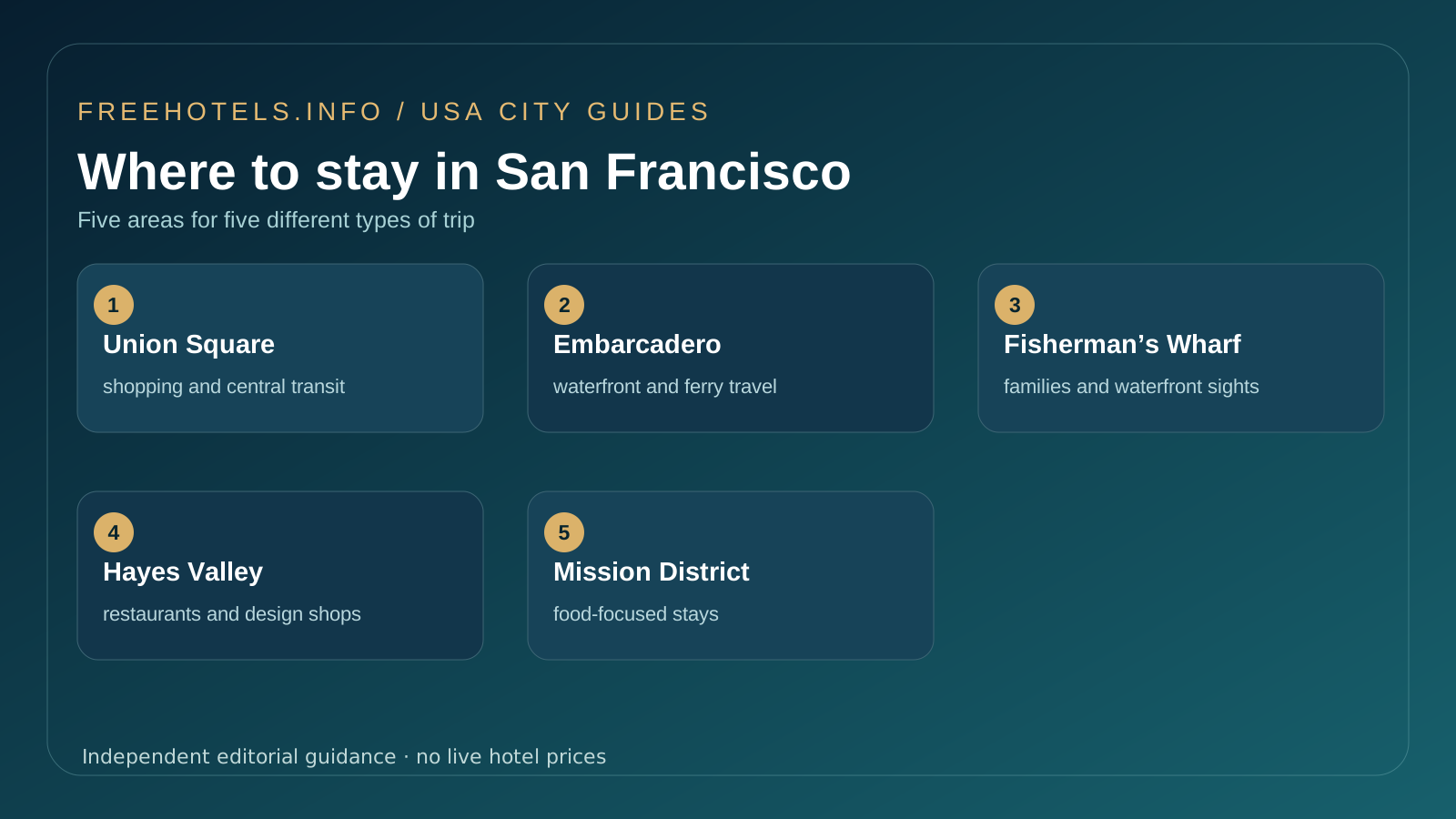
Our short list is Union Square, Embarcadero, Fisherman’s Wharf, Hayes Valley, Mission District. There is no single universally best district. A family planning parks and museums is solving a different problem from someone attending a conference, a sports game or a late-night show. Use your itinerary to eliminate areas first, then compare hotel properties within the two strongest matches. This method reduces last-minute transport surprises and makes prices more meaningful.
For a first-time itinerary, look at Union Square for major hotels and cable-car connections. If food, evenings or local character matter more, Embarcadero or Fisherman’s Wharf may be better candidates, but only when the hotel itself is convenient to the trip. Mission District works for a different set of priorities: food-focused stays. Different areas call for different compromises rather than a fake one-size-fits-all ranking.
Start by plotting each night’s likely return trip. If a tour finishes late, a property that saves a small amount but forces a slow transfer may be the costlier choice. Where two areas look equally convenient, compare unavoidable taxes, any listed facility charges, parking, cancellation deadlines, breakfast and baggage storage. The relevant figure is the total payable cost for the whole party, not the cheapest number in search results.
- First-time visitors: prioritize repeated destinations over a fashionable district name.
- Families: check walks, stairs, room occupancy and realistic evening journeys.
- Drivers: request the exact overnight parking charge before booking.
Union Square: hotels, practical advantages and trade-offs
Union Square is most relevant when your visit is about shopping and central transit. You gain major hotels and cable-car connections. This does not automatically make every property in the district equally convenient: even a familiar neighbourhood name can cover several very different walking routes. Plot your primary sight or meeting location on the map and compare two or three exact hotel addresses. Confirm whether your intended route crosses major roads, climbs hills or requires a transfer.
- Good fit: shopping and central transit.
- Local advantage: major hotels and cable-car connections.
- Check before booking: heavy traffic and variable block ambience.
- Open a map search for Union Square and verify the hotel’s actual entrance and evening journey.
Embarcadero: hotels, practical advantages and trade-offs
Embarcadero is most relevant when your visit is about waterfront and ferry travel. You gain Ferry Building and bay views. This does not automatically make every property in the district equally convenient: even a familiar neighbourhood name can cover several very different walking routes. Plot your primary sight or meeting location on the map and compare two or three exact hotel addresses. Confirm whether your intended route crosses major roads, climbs hills or requires a transfer.
- Good fit: waterfront and ferry travel.
- Local advantage: Ferry Building and bay views.
- Check before booking: higher waterfront hotel rates.
- Open a map search for Embarcadero and verify the hotel’s actual entrance and evening journey.
Fisherman’s Wharf: hotels, practical advantages and trade-offs
Fisherman’s Wharf is most relevant when your visit is about families and waterfront sights. You gain pier attractions and access to ferries. This does not automatically make every property in the district equally convenient: even a familiar neighbourhood name can cover several very different walking routes. Plot your primary sight or meeting location on the map and compare two or three exact hotel addresses. Confirm whether your intended route crosses major roads, climbs hills or requires a transfer.
- Good fit: families and waterfront sights.
- Local advantage: pier attractions and access to ferries.
- Check before booking: tourist crowds and distant BART stations.
- Open a map search for Fisherman’s Wharf and verify the hotel’s actual entrance and evening journey.
Hayes Valley: hotels, practical advantages and trade-offs
Hayes Valley is most relevant when your visit is about restaurants and design shops. You gain independent stores near Civic Center. This does not automatically make every property in the district equally convenient: even a familiar neighbourhood name can cover several very different walking routes. Plot your primary sight or meeting location on the map and compare two or three exact hotel addresses. Confirm whether your intended route crosses major roads, climbs hills or requires a transfer.
- Good fit: restaurants and design shops.
- Local advantage: independent stores near Civic Center.
- Check before booking: fewer big hotels.
- Open a map search for Hayes Valley and verify the hotel’s actual entrance and evening journey.
Mission District: hotels, practical advantages and trade-offs
Mission District is most relevant when your visit is about food-focused stays. You gain restaurants, murals and BART access. This does not automatically make every property in the district equally convenient: even a familiar neighbourhood name can cover several very different walking routes. Plot your primary sight or meeting location on the map and compare two or three exact hotel addresses. Confirm whether your intended route crosses major roads, climbs hills or requires a transfer.
- Good fit: food-focused stays.
- Local advantage: restaurants, murals and BART access.
- Check before booking: street noise and late evenings.
- Open a map search for Mission District and verify the hotel’s actual entrance and evening journey.
Arriving in San Francisco: airport and station transfers
Your arrival point matters almost as much as the neighbourhood. For San Francisco, travellers may use San Francisco International and Oakland. A property that looks close on a regional map can still involve an awkward transfer when you have luggage, arrive late or travel with children. Check official airport ground-transport information for your terminal, not a generic travel blog’s out-of-date route screenshot.
Compare the entire door-to-door route: wait for the next departure, travel time, transfers, the last walk and the cost for the whole party. Where transit requires several changes, a licensed taxi or rideshare might become competitive for a group, but actual quotes depend on date and demand. Conversely, a centrally located hotel with easy transit may spare you vehicle storage charges every night. Keep both options on the table until you have real dates.
- Check arrivals after dark and early departures separately.
- Save a backup ground-transfer option if the final train or bus is missed.
- Confirm luggage storage before check-in and after check-out.
Getting around San Francisco: transit, walking and driving
Muni, BART, ferries and buses is part of the accommodation decision, but do not assume every route operates with the same frequency or coverage. Examine the actual stop served, direction of travel and evening or weekend timetable. The best base for one visitor may be frustrating for someone whose activities are scattered across the metropolitan area. A city-center pin is a starting reference, not a guarantee that every property is reachable on foot.
For a city break, mark the three activities you most want to do, then test trips from each shortlisted hotel. Compare a typical weekday with your actual visiting day, since events and weekend service can change the experience. If you plan to walk, inspect major road crossings, weather exposure and accessibility needs. If the trip involves different districts each day, staying near a useful transfer hub can be more practical than staying closest to just one landmark.
- Map the first and last trip of each day before you reserve.
- Look up the nearest transit stop by its exact name.
- Use official agency alerts on the day of travel.
How to compare hotel prices without invented deals
Published hotel rates change with dates, room availability and booking conditions. We deliberately do not display a ’from’ price that cannot be reproduced for your own dates. Instead, compare at least three properties in your preferred part of San Francisco, keeping check-in, check-out, number of guests, bed configuration and cancellation flexibility constant. A hotel with a lower base price may cost more once unavoidable charges are included.
In San Francisco, pay attention to steep hills, parking and hotel facility fees. Read the final checkout summary for mandatory resort or destination fees, occupancy taxes, card deposits and parking. Distinguish a refundable security hold from a non-refundable charge. A breakfast package is only useful if you would otherwise buy breakfast and can actually use the serving times. Save the full booking conditions as a screenshot or PDF before paying.
- Compare total cost for all travellers, not nightly teaser rates.
- Check mandatory fees and taxes before placing an order.
- Prefer reproducible price quotes to unsupported “best deal” claims.
Family travel, accessibility and longer stays
A good family base reduces the number of difficult transitions in a day. In San Francisco, compare the route from the room to the place you will use most, such as a park, museum, hospital or relative’s neighbourhood. A building on the edge of an appealing district may be less useful than a modest hotel next to a direct transit stop. Room occupancy rules vary: two beds do not automatically mean that four guests are permitted.
When accessibility matters, contact the property to confirm the specific room and route you need. Ask about step-free entrance access, lift dimensions, accessible bathrooms, nearby crossings and the exact transit stations you intend to use. A generic accessibility icon is not enough evidence. If stairs, heavy luggage or heat will be difficult, these practical constraints can outweigh an otherwise appealing neighbourhood.
- Confirm room occupancy and accessibility directly with the property.
- Check grocery, laundry and food options by actual walking route.
- Avoid relying on unverified hotel amenities from map listings.
A simple itinerary test before choosing a neighbourhood
Imagine you have three days in San Francisco. On day one you arrive through San Francisco International and Oakland, check in and go to a nearby restaurant. On day two you explore your main attractions, returning briefly to the room before evening plans. On day three you depart with luggage. Now run that scenario for Union Square, Embarcadero and Fisherman’s Wharf. The best district is the one whose routes cause the fewest frustrating detours, not necessarily the one with the most famous name.
If your priority is restaurants and design shops, include Hayes Valley in that comparison. The location gives you independent stores near Civic Center, but remember fewer big hotels. This is why comparing only neighborhood rankings is insufficient: a good hotel decision is always conditional on your exact trip. If the dates involve peak events, make a second comparison using the cancellation terms rather than just the displayed price.
Treat maps as planning aids rather than live promises. The interactive OpenStreetMap panel on this page can help orient you, while the Google Maps neighbourhood links let you inspect a selected area. Neither map verifies a hotel’s current room stock or rate. Confirm property details with the booking provider, and check that the final address matches the route you approved.
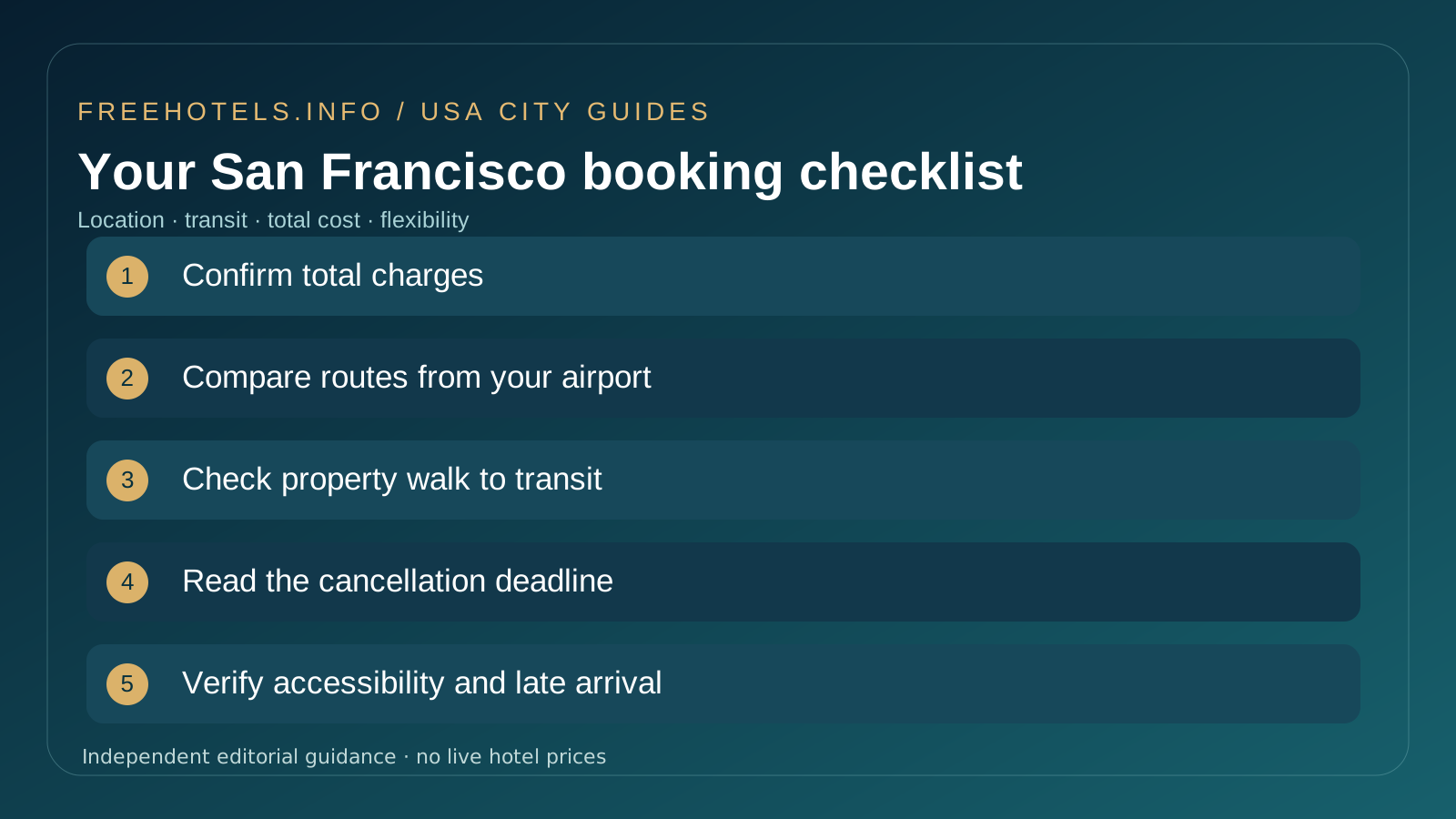
Booking checklist for San Francisco: final verification
Before paying, write down the property’s exact address, the reasons it fits your itinerary, and what would make you reject it. Confirm the same check-in and check-out dates on every comparison page. Look at room photos and verified recent reviews for the particular room category, not just the marketing photographs of the lobby. If your stay includes a quiet night, enquire about the room’s orientation and neighbouring entertainment venues.
For the journey, save the airport or station transfer, the trip to your principal destination, and a practical late return. Re-check transit disruptions close to travel, especially when large events are scheduled. Budget for unavoidable fees and your likely transport use rather than the advertised room rate alone. If the property has a parking facility, request the complete charge and entry conditions, not merely the presence of a parking icon.
- Check the actual booking address and neighbourhood, not just the marketing label.
- Verify two real routes, including one evening or early-morning journey.
- Confirm all mandatory charges, taxes, deposits and parking.
- Save cancellation conditions and contact details before payment.
Related verified hotel guides
- Where to Stay in Columbus: Best Neighborhoods for Every Traveler
Compare another major US destination and its neighbourhoods.
- Where to Stay in Indianapolis: Best Neighborhoods for Every Traveler
Compare another major US destination and its neighbourhoods.
- Where to Stay in Seattle: Best Neighborhoods for Every Traveler
Compare another major US destination and its neighbourhoods.
- Where to Stay in Denver: Best Neighborhoods for Every Traveler
Compare another major US destination and its neighbourhoods.
Common questions
What is the best area to stay in San Francisco for first-time visitors?
Start with Union Square if your itinerary focuses on shopping and central transit, because of major hotels and cable-car connections. Compare the exact hotel address against the attractions you intend to visit, rather than assuming every property in the district is equally convenient.
Where should families stay in San Francisco?
Consider Mission District for food-focused stays, or Hayes Valley if independent stores near Civic Center suits your plans. Check room occupancy, step-free access, the evening journey and nearby groceries rather than relying on area labels alone.
Do I need a car in San Francisco?
Muni, BART, ferries and buses. A car may simplify dispersed activities, while hotels near a useful line may make driving unnecessary for a compact itinerary. Include parking and transfer costs before deciding.
Are hotels in San Francisco cheaper outside downtown?
Some noncentral areas may have lower base prices, but dates and hotel supply determine real quotes. Add transfers, parking, taxes and time costs before treating a lower nightly rate as a saving.
How can I avoid hidden hotel charges in San Francisco?
Look for steep hills, parking and hotel facility fees. Review mandatory fees and taxes at final checkout, verify the cancellation deadline and confirm whether a security hold is refundable.
Sources
- US Census Bureau: 2025 incorporated-city estimates (selection of 30 cities)
- OpenStreetMap contributors: live geographical context and route checks
- Wikimedia Commons: San Francisco Skyline - Mission Dolores Park.jpg — image credit and licence
- Google Maps: verify specific neighbourhood routes and local services